



FIBER- Why it’s important and Recipes
Fiber is the most underestimated macronutrient in your diet and is KEY to reducing small dense LDL, reducing blood sugar and managing your hunger. WHERE you get your fiber from is important. Fiber gummies are generally NOT good sources of fiber. Dave’s Killer bread is good marketing but not a good source of fiber either as it offer three times more sugar than fiber. Fiber from whole, real foods, unprocessed foods is our key target. If you eat a “fiber enriched” cereal that is processed/man made, the glycemic index (release of sugar/carbs) will be very high and the small amount of fiber in that food will not be beneficial. Glycemic Index means how fast something will turn into sugar in your body. The more fiber you have, the lower the glycemic index. For example, a white potato has very little fiber, it’s mostly carbohydrates which turns into sugar very quickly. Let’s say you ate 15 grams of fiber with that white potato, then the glycemic index would be lower (more healthy). The potato would not raise your blood sugar as much.
The intake of fiber slows down your overall digestion which is hugely beneficial. This slowing allows for greater digestion, slower rise in blood sugar, more binding of sugar and cholesterol in the gut so that less of these enter the blood stream. And as I will discuss later, fiber is the primary fuel that feeds the healthy bacteria in the gut, the microbiome, that serves to stabilize and promote a healthy immune system. Fiber is a mild mannered superhero.
Fiber & Net Carbs: Why Fiber Matters
Not all carbohydrates affect your body the same way. Fiber is a type of carbohydrate that your
body cannot fully digest, so it does not raise blood sugar the way digestible carbohydrates do.
Net carbs = Total carbohydrates − Fiber
For example, if a food contains 20 grams of total carbohydrates and 8 grams of fiber, it has approximately 12 grams of net carbs. It is these net carbs that will get digested into to sugar and used by the body to generate cellular energy. This sounds great and suggests that more carbs = more energy but unfortunately there is a critical threshold. If we take in more carbs than our body needs then we simply convert those carbs to fat and store them as fat in our belly fat, our liver, our pancreas, and even in the tissue around our heart.
Fiber slows digestion and the absorption of glucose, which can result in a more gradual rise in blood sugar. Certain types of soluble fiber can also bind to bile acids in the digestive tract, helping the body remove cholesterol. The take away: Higher-fiber foods means fewer digestible carbohydrates, a slower blood-sugar response, and greater satiety. Fiber helps us to feel “fuller – longer”. People who eat high fiber diets tend to consume fewer calories overall as they aren’t as hungry. Processed foods, anything in a box, bag or can, is typically lower in fiber and will actually increase hunger and increase total daily calorie intake thus driving weight gain.
Another benefit of fiber- fiber helps regulate digestion and proper elimination (keeps you from being constipated) and helps feed the good bacteria in your gut. Unlike many carbohydrates that are broken down and absorbed in the small intestine, certain types of fiber (resistant starch) make it to the colon, where your gut bacteria can ferment them. If you are struggling with constipation or hard stools, fiber will be your best tool.
Recipe for Poop = Fiber + Water
Here are the top sources of fiber:
Food
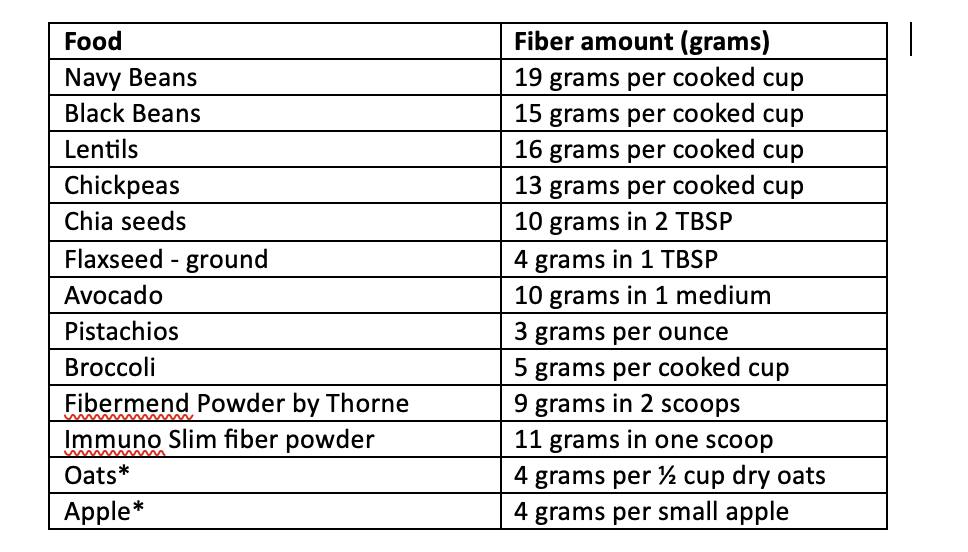
*These foods are higher in carbs, so don’t over eat these foods. However, the fiber found in oats contains a beneficial soluble fiber called beta-glucan. Apples contain a beneficial fiber called pectin. These fibers help reduce cholesterol and manage blood sugar.
In general, most nuts, seeds, vegetables and beans are good sources of fiber. Using a high quality fiber powder such as Fibermend or Immuno Slim can help fill in any gaps in your diet.
- FiberMend is a commercial fiber powder made by Thorne Research and unlike other fiber products it has been tested to ensure that it is free of mold toxins, chemicals, pesticides and other noxious elements.
- Immuno Slim is an amazing product that contains 11 grams of fiber in one scoop of powder and actually tastes good. It contains 11 different kinds of fiber including the valuable resistant starch mentioned above.
How much fiber should you eat per day?
The goal is 25-30 grams per day. You can calculate your fiber intake by using Myfitnesspal or AI (ChatGPT). Simply input your food intake into AI and it will very quickly calculate how many grams of fiber you ate that day. Keep track for at least 2 weeks to get an idea of your average fiber intake. Studies report that the average American often gets a mere 10-12 grams of fiber daily which is only HALF of your ideal goal.
Putting it all together
Below are some recipes to help boost your fiber intake but allow me to offer some ideas on comprehensive solutions. Pick from the foods list above and from the recipes below some options that appeal to you. There is plenty of variety but it comes together more easily when you plan ahead. Here are a few ideas.
- Salads are an easy addition to any diet. Each serving of raw vegetable (1 cup) offers on average 4 grams of fiber. If I make a salad using 3 cups of mixed vegetable including lettuce there is 12 grams right there. If I had a ¼ cup of black beans that adds another 4 grams. Sprinkle on a teaspoon of chia seeds adds another 1.5 grams and this salad has a minimum of 17 grams of fiber.
- Smoothie – making a protein smoothie is easy, fast and a high fiber option if you simply add vegetable, green banana flour, chia or flax seeds to the mix. I often add the Immuno Slim fiber powder (11 grams), 2 cups of vegetable like carrot, celery, or broccoli (8 grams) plus 1 TBSP of ground flax seed (4 grams) delivering a total of 23 grams of fiber per shake.
- Over Night Oats recipe below delivers 15 grams of fiber and this keeps me feeling very full all morning long. Now all I need is to get some hummus with vegetables and I am easily over 25 grams for the day.
- Muffins – the recipe below for Keto Cinnamon Muffins is a favorite and offers 3.4 grams pf fiber per muffin so simply add this to your salad, dinner, or as a snack.
- Kirkland’s (Costco) “Mixed Nut Butter” is a tasty high fiber alternative to the classic peanut butter. It is made from almonds, cashews, pumpkin seeds, chia seed and flax seed. There are 2.5 grams of fiber per tablespoon. Spread that over an apple or a Keto Cinnamon Muffin and enjoy.
Crispy Lentil "Crunch" Salad
INGREDIENTS:
- 1½ cups cooked green or brown lentils
- 2 cups chopped romaine
- 1 cup shredded cabbage
- ½ cucumber
- ½ cup carrots
- ¼ avocado
- Fresh herbs
Crispy lentils
Toss cooked lentils with:
1 tbsp olive oil
Garlic powder
Paprika
Cumin
Salt
Roast at 400°F for ~25–30 minutes, tossing halfway.
Top salad with crispy lentils and lemon-olive oil dressing.
Chia Seed Pudding Recipe (Base recipe = 10 grams of fiber. Adding fruit adds more fiber)
INGREDIENTS
- 2 tablespoon chia seeds
- 1/2 cup almond milk or milk of choice
- 1 teaspoon stevia sweetener, or allulose or preferred sweetener - optional
- Strawberries, blueberries or other fruits for topping. ¼ cup raspberries = 2 grams fiber.
- Cinnamon is optional
INSTRUCTIONS
- Pour ingredients into a jar and mix well. Let settle for 2-3 minutes then mix again very well until you see no clumping.
- Cover the jar and store in fridge overnight or for at least 2 hours.
- When you’re ready to eat it, top with your favorite fruit and enjoy cold!
Over Night Oats (15 grams of fiber)
INGREDIENTS
- ¼ cup of raw Steel cut oats
- ¼ cup of raw rolled oats
- 1 TBSP of ground chia seeds
- 1 TBSP of ground flax seeds
- 1 teaspoon of organic green banana flour
- ¼ cup of walnuts or pecans – break into smaller pieces.
- 1 TBSP collagen powder
- 1 scoop of Thorne Research vanilla whey protein powder
- 1 heaping teaspoon of ground cinnamon
- 1 teaspoon of sweetener – Allulose or Monk fruit or Stevia
- Favorite milk – almond, oat, soy, etc.
INSTRUCTIONS
- Using a simple 1 pint sized Ball jar, add all dry ingredients.
- Consider making 3 or 4 of these at a time and storing for later use.
- The night prior to intended consumption, mix in enough milk to fill the jar.
- Roughly ½ cup but simply judge need and play with consistency.
- Mix well. Should be a soupy consistency as it will firm up overnight.
- Store in the refrigerator overnight – ready to go in the morning.
Keto Cinnamon Muffins Makes 12 muffins – each muffin has 3.4 grams of fiber.
INGREDIENTS
- 1 cup Flaxseed Meal gold or dark flaxseed meal
- 1 cup Almond Flour
- 1 tablespoon Baking Powder or 1/2 tablespoon baking soda
- 2 teaspoons Ground Cinnamon
- ½ cup + 2 tablespoons of Allulose artificial sweetener.
LIQUID INGREDIENTS
- 4 large Eggs at room temperature
- ½ cup Unsweetened Almond Milk or coconut milk
- ½ cup Coconut Oil melted or melted butter
SWEET CINNAMON MIX - Topping
- 2 tablespoons Monk Fruit or Allulose
- 1 teaspoon Ground Cinnamon
INSTRUCTIONS
- Preheat oven to 180°C (350°F). Line a non-stick 12-hole muffins tray with paper cups or grease the holes slightly with coconut oil. Set aside. In a large mixing bowl, combine all the dry ingredients. Set aside. In another bowl, whisk the liquid ingredients together. If you are using melted coconut oil, make sure all the ingredients are at room temperature. If you add melted coconut oil on cold eggs (eggs coming straight away from the fridge), the coconut oil makes lumps and solidifies. To avoid that, use melted butter or eggs at room temperature.
- Pour the liquid ingredients onto the dry and combine until it forms a thick muffin batter.
- Fill each muffin hole with the batter. I recommend using a mechanical ice cream scoop to be precise and create muffins of the same size (and the same amount of carbs per serving).
- In a small bowl, prepare the “Sweet Cinnamon Mix” topping.
- Sprinkle the Sweet Cinnamon Topping on top of each muffin before baking.
- Keep some to dip the top of the hot muffins into if you like, optional but tasty!
- Bake for 20 minutes or until a skewer inserted in the center of the muffins comes out clean or with no crumbs on it.
High Fiber FAT BOMB
INGREDIENTS
- 2 tbsp hemp seed
- 2 tbsp ground flax seed
- ½ cup coconut oil
- ½ cut nut butter. Using Costco “Mixed Nut Butter” would increase fiber load.
- 1 scoop chocolate protein powder
INSTRUCTIONS
- Melt all ingredients into a sauce pan. Stir frequently. Pour liquid into a glass container. Place in the refrigerator for 2 hours. Enjoy!
Delicious Coconut Cream Chocolate Pudding High fiber dessert.
INGREDIENTS
- 2 cans of full fat coconut CREAM (not milk)
- 3 tbsp unsweetened coco powder
- 2 tsp vanilla extract
- 2 tsp Stevia (or to taste)
- 4 tbsp ground flax seed or chia seed
INSTRUCTIONS
- Place the 2 cans of coconut cream in the refrigerator for 4 hours. Once cooled, pour cream into a large bowl
- Beat with an electric beater for 5 minutes
- Add the coconut powder, seeds, vanilla extract and stevia. Beat for another minute.
- Keep in the refrigerator. Enjoy!
- Batch total fiber: With flax: about 13–18 g fiber. With chia: about 22–27 g fiber.
High Fiber Bean Dip
INGREDIENTS
- 1 clove garlic
- 2 cups dried beans, soaked overnight, or 2 cans of prepared beans
- 4 tbsp lemon juice
- 1 jalapeno
- 2 tbsp tahini
- 2 tbsp extra virgin olive oil
- ½ tbsp curry powder
- ½ tbsp cayenne pepper
- ½ tbsp coriander
- ½ tbsp turmeric
INSTRUCTIONS
- Add everything into the food processor and pulse. Do this until you get a nice creamy mixture.
- Refrigerate leftover dip.
